Q1. With respect
to the trait for dwarfness of a plant, the trait for tallness of a plant is
Solution
In pea plant
as per the Mendelian inheritance pattern, the trait for tallness of a plant
is dominant, present on the same loci of homologous chromosomes as the trait
for dwarfness of the plant and is always expressed when present with its
other allelomorphs.
Q2. ZZ/ZW type of sex determination is seen in
Solution
ZZ/ZW type of sex determination is seen in fish, reptiles, birds, butterflies and moths.
ZZ/ZO type of sex determination is seen in some butterflies and moths.
XX/XO type of sex determination is seen in cockroach and some roundworms.
XX/XY type of sex determination is seen in mammals and most insects.
Q3. The blood
group antigens found on the surface of RBCs are
Solution
Human blood
group is governed by the gene ‘I’. This gene is responsible for the
production of a glycoprotein antigen which is found on the surface of the
RBCs. The type of sugar found in these glycoprotein molecules determines the
blood group of the individual (A, B, AB or O).
Q4. The enzyme
tyrosinase is linked to which disease?
Solution
In albinism,
the individual lacks the enzyme tyrosinase, which is necessary for the
synthesis of the dark pigment melanin.
Q5. Which of the
following diseases is also known as bleeder’s disease?
Solution
Haemophilia
is an X-linked recessive disease. In this case, the affected individuals
carry a defect due to which the blood fails to clot and the person may bleed
to death even with minor injuries.
Q6. An individual with Klinefelter’s syndrome possess
how many chromosomes?
Solution
Klinefelter’s syndrome is an aneuploid condition wherein
the individual possesses three sex chromosomes. Hence, the individual has one
extra chromosome than normal (represented by 2n +
1).
Q7. The term ‘Genetics’ was proposed by
Solution
Mendel is regarded as the Father of Genetics.
Thomas Hunt Morgan elucidated the role of chromosomes in heredity.
Johannsen coined the term gene.
Q8. Mating
of an organism to a double recessive in order to determine whether it is
homozygous or heterozygous for a character under consideration is called
Solution
A
reciprocal cross involves same traits but is carried by sexes opposite to
those in the original or first cross.
A
back cross is a genetic cross between a hybrid organism and one of the
original parental types.
A
dihybrid cross is a cross which deals with two pairs of contrasting
characters at the same time.
Q9. How does a test cross help in identifying the genotype of the organism? Explain.
Solution
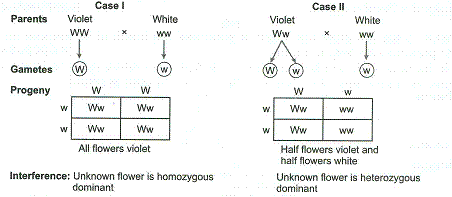
In a typical test cross, an organism showing a dominant phenotype (whose genotype is to be determined) is crossed with the recessive parent. The progeny of the cross are analysed to predict the genotype of the
test organism. Given below is a test-cross where the
violet colour flower of pea (W) is dominant over the white colour flower (w).
Q10. An allele
which is dominant and widespread in the population is known as a
Solution
An allele
which is dominant and is widespread in the population is known as a wild
allele.
Q11. A mutation
in which the codon ATC changes to GTC is classified as which type of a
mutation?
Solution
When the
codon ATC changes to GTC, the nitrogen base in the codon is changed from A to
G, while the rest of the nitrogen bases remain the same. Because both A and G
are purines, the mutation is a transition mutation.
Q12. Klinefelter's syndrome
is due to
Solution
Klinefelter's syndrome
is an aneuploid condition with three sex chromosomes. It is caused by XXY
genotype. This genotype results from the union of a non-disjunct XX egg and a
normal Y sperm or a normal X egg and an abnormal XY sperm. The individual has
47 chromosomes (2n + 1).
Q13. Name one autosomal dominant and one autosomal recessive Mendelian
disorder in humans.
Solution
Huntington's disease is an autosomal dominant disorder and haemophilia
is an autosomal recessive disorder.
Q14. In one family, each of the four children has a different blood group. The mother is group A and the father is group B. Explain this pattern of inheritance with the help of a cross along with their genotypes.
Solution
A
cross is carried out between
the heterozygous father (for blood group B) and the heterozygous mother (for blood group A) to get four children with different blood groups.
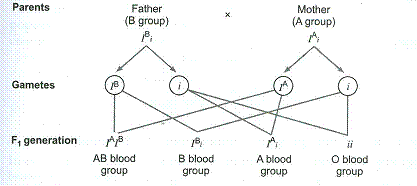 All the four blood groups are controlled by three allelic genes IA, IB,
i which exhibit an instance of multiple allelism. Both
IA and IB are dominant over i. However,
when together, both are dominant and show the phenomena of co-dominance, forming the blood group AB. Six genotypes are possible with the combination of these three alleles.
All the four blood groups are controlled by three allelic genes IA, IB,
i which exhibit an instance of multiple allelism. Both
IA and IB are dominant over i. However,
when together, both are dominant and show the phenomena of co-dominance, forming the blood group AB. Six genotypes are possible with the combination of these three alleles.
All the four blood groups are controlled by three allelic genes IA, IB,
i which exhibit an instance of multiple allelism. Both
IA and IB are dominant over i. However,
when together, both are dominant and show the phenomena of co-dominance, forming the blood group AB. Six genotypes are possible with the combination of these three alleles.
Q15. The presence
of pink-coloured flowers in snapdragon is due to
Solution
In
snapdragon, the true parental types are white- and red-coloured flowers. When
a pure white flower parent is crossed with a true breeding red-coloured
flower parent, the progeny show the presence of pink-coloured flowers. This
is because the alleles for the red and white trait are both dominant and when
present together are expressed as a mixture of the two traits. This
phenomenon deviates from the Mendelian inheritance pattern and is known as
incomplete dominance.
Q16. Which of the
following individuals is a genetically pure individual for the given trait?
Solution
Individuals
in which both the alleles of a character at the corresponding loci of the
homologous chromosome are identical are known as homozygous or pure
individuals for that trait.
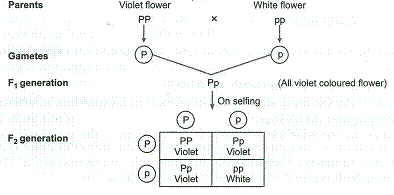
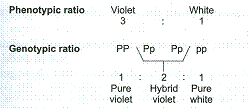
Q17. Work out F1 and F2 generation to explain the
inheritance of flower colour in Pisum sativum. Give the phenotypic and
genotypic ratios (start with pure breeding).
Solution
This is a case of Mendel's monohybrid cross.
Q18. Which of the
following characters was not considered by Mendel in his inheritance studies?
Solution
In his
inheritance studies on garden pea, Mendel considered 7 different characters—type
of stem (tall/dwarf), position of flowers (axial/terminal), pod colour
(green/yellow), pod type (inflated/constricted), flower colour
(coloured/white), colour of cotyledons (yellow/green) and seed shape
(round/wrinkled).
Q19. Turner syndrome is
Solution
Turner’s syndrome is an aneuploid condition with a single set of chromosomes. It is caused by XO genotype which results from the union of an abnormal O egg with a normal X sperm or a normal X egg and abnormal O sperm.
Q20. Colchicine
is a mutagen which results in
Solution
Colchicine
is a chemical mutagen which prevents the formation of spindle fibres during
cell division and results in the lack of splitting up of chromosomes,
resulting in the formation of polyploids.
Q21. In which of
the following organisms are sperms formed by the process of mitosis?
Solution
In certain
organisms, the unfertilised egg develops into a male, while the fertilised egg
develops into a female. This is the haploid-diploid system of sex
determination. It is observed in ants, bees, wasps and saw flies.
Q22. Lack
of independent assortment of two genes A and B in fruit fly Drosophila is due to
Solution
The
genes located on the same chromosome (linked genes) usually do not assort independently
but remain together in the gametes and the offspring.
Q23. The
frequency of crossing over between two genes is directly proportional to
Solution
The
frequency of crossing over between two genes is directly proportional to the
distance between them. This is the Morgan and Sturtevant’s hypothesis.
Q24. Which of the blood groups can be given to any person?
Solution
There are four blood groups in the human population - A, B, AB and O depending on the type of glycoprotein (antigen) present on the surface of the blood corpuscles. People with blood group A produce A antigen, those with blood group B form B antigen, those with blood group AB produce both the antigens and those with blood group O form no antigen. As people with blood group O have no antigen on the surface of their red blood cells, they act as universal donors. Their blood type is compatible with any blood type.
Q25. Down's syndrome is due to
Solution
Down's syndrome is caused by the presence of an extra chromosome no. 21. Both the chromosomes of the pair 21 pass into a single egg due to non-disjunction during oogenesis in the mother’s ovary.
Q26. Individuals with
sickle cell anaemia have a less chance of suffering from which of the
following diseases?
Solution
Individuals
with sickle cell anaemia possess sickle-shaped RBCs. The malaria parasite
reproduces in the RBCs of the affected individual. Due to the abnormal shape
of the RBCs in individuals with sickle cell anaemia, the parasite fails to
reproduce and hence has a less chance of affecting the individual.
Q27. When a tall pea plant was self-pollinated, one-fourth of the progeny was
dwarf. Give the genotype of the parent and dwarf progeny.
Solution
The genotype of the parent is Tt and the genotype of the dwarf progeny
is tt.
Q28. What is gene locus?
Solution
Gene
locus is the particular location or position where a gene is located on a
chromosome.
Q29. Haemophilia is due to
Solution
Haemophilia is a sex-linked trait caused by a recessive gene located in the X-chromosome. This gene controls the synthesis of a coagulation protein called factor VIII needed for clotting of blood.
Q30. Which of the
following factors increases the strength of linkage between genes?
Solution
The chance
of crossing over between genes reduces as the age of an individual increases,
thus increasing the strength of linkage between them.
Q31. Mendel
referred to genes as
Solution
Mendel referred
to genes as factors before the word gene was introduced by Johannsen in 1909.
Q32. Inheritance pattern of ABO blood group in humans shows dominance, co-dominance and multiple allelism. Explain each concept with the help of blood group genotypes.
Solution
Dominance: The alleles IA and IB
are dominant over allele i as IA and IB form antigens A
and B, respectively, but i does not form any
antigen.
Co-dominance: Both the alleles IA
and IB are co-dominant as both of them are able to express themselves in the presence of each other in blood group AB (IAIB) by forming antigens A and B.
Multiple allelism: It is the phenomenon of occurrence of a gene in more than two allelic
forms on the same locus. The
ABO blood group in humans is determined by three
different allelic forms IA, IB and i.
The above three explanations prove that the
inheritance of ABO blood group in humans shows dominance, co-dominance and
multiple allelism.
Genotype
Surface
antigen
Blood
group
IAi
A
A
IAIA
A
A
IBi
B
B
IBIB
B
B
IAIB
AB
AB
ii
-
O
Q33. Muscular
dystrophy is caused by
Solution
Muscular
dystrophy is a disease in humans which is caused by a frameshift mutation in
the gene responsible for the production of the protein dystrophin. In this
disease, the mutation leads to premature termination of translation of the
protein.
Q34. During his
studies on genes in Drosophila which were sex-linked, T. H. Morgan found that the population phenotypic ratios deviated from the expected 9:3:3:1 ratio. Explain the
conclusion he arrived at.
Solution
(i) T.
H. Morgan observed that when the two genes in a dihybrid cross are located on the
same
chromosome, the proportion of parental gene combinations in the progeny was much higher than the non-parental or recombination of genes.
(ii) Morgan and his colleagues
found that when genes were grouped on the same chromosome, some genes are tightly linked and show less recombination.
(iii) When the genes are loosely linked, they show higher recombination.
Q35. A human being suffering from Down's syndrome shows trisomy
of 21st chromosome. Mention the cause of this chromosomal
abnormality.
Solution
In Down’ syndrome, due to non-disjunction, the 21st pair of
chromosome fails to separate during oogenesis. Therefore, the egg possesses
24 chromosomes instead of 23. When the egg fuses with a sperm, the zygote has
three copies of chromosome 21 resulting in trisomy.
Q36. (i) State
the principle of independent assortment.
(ii) How
would the following affect the phenomenon of independent assortment?
(a)
Crossing over (b) Linkage
Solution
(i) The law of independent assortment states that
the alleles of different characters located in different pairs of homologous
chromosomes are independent of one another in their segregation during gamete
formation and in coming together into the offspring by fertilisation, both
processes occurring randomly.
(ii) (a) Crossing over:
Crossing over influences linked genes. As a result, 50% recombination is
obtained in the test cross progeny.
(b) Linkage: It influences recombination which is
less than 50%.
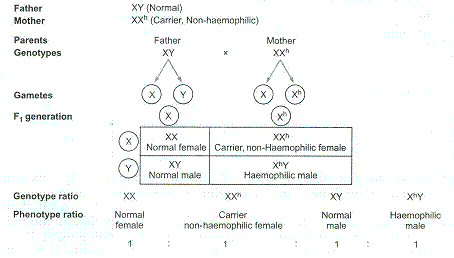
Q37. A non-haemophilic couple was informed by their doctor that there is a possibility of a haemophilic child
to be born to them. Explain the basis on which the doctor conveyed this information. Give the genotypes and the phenotypes of all possible children who could be born
to them?
Solution
The doctor
must have conveyed this information
on the basis of pedigree analysis. Pedigree analysis
is a strong tool used to trace the inheritance of a specific trait, abnormality or a disease. Because
both
the parents are non-haemophilic, their genotypes will be
Q38. (a)
You are given tall pea plants with yellow seeds whose genotypes are
unknown. How would you find the genotype of these plants? Explain with the help of a cross.
(b) Identify a, b and c in the table
given
below:
Sr.
No.
Pattern
of inheritance
Monohybrid
F1 phenotypic expression
1.
Co-dominance
a
2.
b
The progeny resembled only one of the parents
3.
Incomplete dominance
c
Solution
(a) Test cross will be performed to know the genotype of
the given tall pea plants with
yellow seeds.
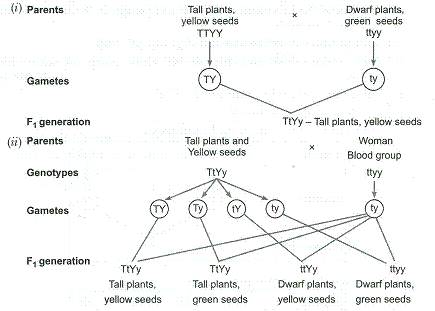 If
all the plants of the F1
generation are tall with yellow seeds, then the parent is homozygous dominant (Case i). If the plants in the F1 generation are
in the ratio 1:1:1:1, then the parent plant is heterozygous dominant.
(b)
a: Both the forms of a trait are equally expressed in the
F1 generation.
b:
Dominance
c:
Phenotypic expression of the
F1 generation is somewhat intermediate between the two parental forms of a trait.
If
all the plants of the F1
generation are tall with yellow seeds, then the parent is homozygous dominant (Case i). If the plants in the F1 generation are
in the ratio 1:1:1:1, then the parent plant is heterozygous dominant.
(b)
a: Both the forms of a trait are equally expressed in the
F1 generation.
b:
Dominance
c:
Phenotypic expression of the
F1 generation is somewhat intermediate between the two parental forms of a trait.
If
all the plants of the F1
generation are tall with yellow seeds, then the parent is homozygous dominant (Case i). If the plants in the F1 generation are
in the ratio 1:1:1:1, then the parent plant is heterozygous dominant.
(b)
a: Both the forms of a trait are equally expressed in the
F1 generation.
b:
Dominance
c:
Phenotypic expression of the
F1 generation is somewhat intermediate between the two parental forms of a trait.
Comments
Post a Comment