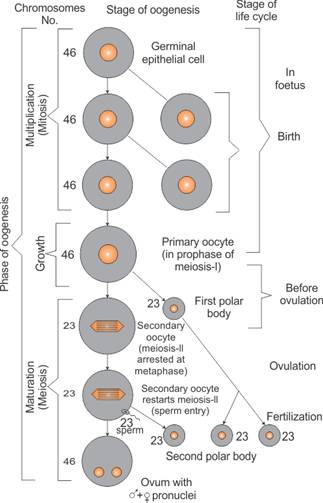
Q1. Give a schematic labelled diagram to represent oogenesis (without description).
Solution
Stages in oogenesis
Q2. Antrum is the cavity of:
Solution
The characteristic structural unit of the Graafian follicle is the antrum.
Q3. The external sphincter of the urethra shows the
presence of which type of cells?
Solution
The external sphincter of the urethra shows the
presence of striated muscle fibres around its membranous part, while the
internal sphincter shows the presence of smooth muscle fibres at its
beginning.
Q4. Corpus luteum in mammals
occurs in:
Solution
The follicular cells of
the empty Graafian follicle form a yellow body called corpus luteum. The
corpus luteum secretes progesterone and a smaller amount of estradiol.
Q5. Seminal plasma, the fluid
part of semen is contributed by:
(i) Seminal vesicle (ii) Prostate
(iii) Urethra (iv) Bulbourethral gland
Solution
Seminal
plasma, the fluid part of semen is contributed by seminal vesicle, prostate
and bulbourethral gland, which are the parts of male reproductive system.
Urethra is a part of the female reproductive system.
Q6. The ploidy level of each polar body formed in
oogenesis is
Solution
The polar body is formed during meiosis-II and hence
is haploid.
Q7. Cessation
of menstrual cycle in female is called:
Solution
A
woman stops producing mature eggs and ceases her menstrual cycle in her late
40s or early 50s. This phase is called menopause.
Q8. Which of the following occurs during
spermatocytogenesis?
Solution
During spermatocytogenesis, the DNA of the cell
replicates and the cytoplasm is added to the developing sperm.
Q9. The cell organelle which forms the acrosome of the
sperm is
Solution
Some part of the Golgi body forms the acrosome, while
the rest of it is lost during sperm formation.
Q10. Which one of the following arises from endoderm?
Solution
Eye, pigment cells and heart arise from the mesoderm.
Q11. The development of the ova completes after
Solution
An ovum is released after the secondary oocyte stage
and its maturation is completed after fertilisation.
Q12. Morula is a developmental stage:
Solution
Morula is a developmental stage
between the zygote and blastocyst. It consists of
16-32 cells.
Q13. How many sperms will be produced from 10 primary spermatocytes
and how many eggs will be produced from 10 primary oocytes?
Solution
10 primary spermatocytes will produce 40 sperms and
10 primary oocytes will produce 10 eggs.
Q14. A human
female reaches menopause around the age of:
Solution
Woman
stops producing mature eggs and ceases her menstrual cycle in her late 40s or
early 50s.
Q15. A
fluid-filled cavity present within blastula is called:
Solution
The fluid absorbed by the trophoblast
layer of the blastula collects in a cavity, the blastocoel
or blastocyst cavity that separates the trophoblast from the inner cell mass.
Q16. At the end of pregnancy, the hormone relaxin is secreted by
Solution
The corpus luteum secretes
two hormones—progesterone during pregnancy and relaxin at the end of
pregnancy.
Q17. Uterine contractions during parturition are
stimulated by
Solution
During parturition, the posterior pituitary releases
oxytocin which stimulates the contraction of the uterine walls.
Q18. Which of the following components is found in a
higher concentration in human milk as compared to cow’s milk?
Solution
Human milk contains a higher concentration of
lactose (7 g/100 ml) as compared to cow’s milk (4.8 g/100 ml).
Q19. What is parturition? Which hormones are involved in it?
Solution
Parturition
is the act of expelling the fully developed young one (foetus) from the
mother's uterus at the end of gestation period. Oxytocin and relaxin hormones
are involved in parturition.
Q20. The inability of a male to achieve or hold onto an
erection for complete copulation is known as
Solution
The inability of a male to achieve or hold onto an
erection for complete copulation is known as impotence. Sterility is the
inability of the male sperm to fertilise the ovum. Prostatic hypertrophy or
prostatomegaly is the enlargement of the prostate gland.
Q21. What is the amount of milk produced by a lactating
mother per day?
Solution
A lactating mother produces about 1-2 litres of milk
per day.
Q22. Spermiation is the process of the release of sperms from:
Solution
The process of release of spermatozoa or sperms from Sertoli cells into the cavity of seminiferous tubules is called spermiation.
Q23. The
complete development of a sperm in the male reproductive system takes how
much time?
Solution
The
complete development of a sperm in the male reproductive system takes about 2
months.
Q24. Cervix is a part:
Solution
The cervix communicates
above with the body of the uterus by an aperture, the internal os and with
the vagina below by an opening, the external os.
Q25. Which stage of the cell cycle is skipped during
cleavage of the zygote?
Solution
During cleavage of the zygote during embryonic
development, the cells of the developing embryo undergo mitotic divisions and
undergo only the M and S phases of the cell cycle. The cells entirely skip
the G1 and G2 phases of the cell cycle.
Q26. The
septa of the testis is formed by the inward growth of
Solution
The
tunica albuginea shows inward growth in the testis, called septa, which
divides each testis into 200 to 300 lobules.
Q27. Give the function of:
(a) Corpus luteum (b) Endometrium
Solution
(a)
Corpus luteum: It secretes progesterone which
prepares endometrium of the uterus for implantation and normal development of
the foetus.
(b)
Endometrium: It undergoes cyclic changes during
menstrual cycle and prepares itself for implantation of the blastocyst.
Q28. Differentiate between menarche and menopause.
Solution
The beginning of first menstrual cycle at puberty in human
females is called menarche. The cessation of menstrual cycle in women around
50 years of age is called menopause.
Q29. The middle portion of the epididymis
is known as
Solution
The epididymis is divided
into three regions—the upper, wider portion known as the caput epididymis, the middle narrow corpus epididymis
and the lower cauda epididymis.
Q30. Crossing over in gamete formation occurs during
Solution
Meiosis-I is associated with crossing over of
homologous chromatids, which introduces variations in the chromosomes and the
gametes thus formed.
Q31. The plasma membrane of the ovum is known as
Solution
The plasma membrane of the ovum is known as the
oolemma. The cytoplasm is known as the ooplasm. Alecithal is the condition of
lacking a yolk sac in the ovum. Zona pellucida is the inner, transparent, non-cellular
egg coat of the ovum.
Q32. The
receptors found on the zona pellucida of the ova which recognise and bind to
the sperm are
Solution
ZP3
receptors are glycoproteins found on the zona pellucida which recognise and
bind the sperms and induce the acrosome to release hydrolytic enzymes.
Q33. Why
are menstrual cycles absent during pregnancy?
Solution
When
pregnancy occurs, high levels of progesterone and estrogens suppress the
gonadotrophin (FSH). The
latter is required for the development of new follicles. Thus, new menstrual
cycle cannot be initiated as long as FSH secretion is suppressed. So,
menstrual cycles are absent during pregnancy
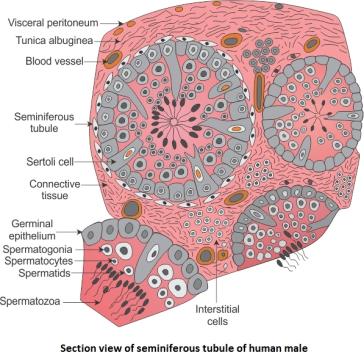
Q34. Draw a labelled section view of seminiferous
tubule of a human male.
Solution
Section view of seminiferous
tubule of a human male
Q35. Where are the Leydig cells present? What is their role in reproduction?
Solution
Leydig cells are small groups of large, polygonal cells
that lie in the connective tissue present between the seminiferous tubules.
They secrete androgens, the male sex hormone (e.g. testosterone) into the
blood.
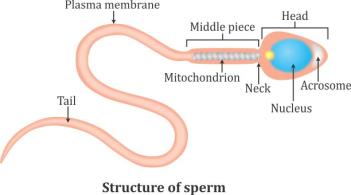
Q36. In which part of sperm,
mitochondria are present?
Solution
The middle piece contains
many mitochondria tightly coiled round the axial filament. The mitochondria
provide energy for the movement for sperm in the female genital tract.
Q37. Where are fimbriae present
in human female reproductive system? Give their function.
Solution
The funnel-shaped proximal
part of the fallopian tube is called infundibulum. Its margin bears motile,
finger-like processes called fimbriae. The fimbriae bear cilia that beat
towards the operature (called ostium) to direct the release of egg (from
ovary) into the infundibulum.
Q38. Study the figure given below and answer the questions that
follow:
 (a) Name the stage of human embryo the figure represents
(b)
Identify 'a' in the figure and mention its function.
(c)
Mention the fate of the inner cell mass after implantation in the uterus.
(d) Where are the stem cells located in this embryo?
(a) Name the stage of human embryo the figure represents
(b)
Identify 'a' in the figure and mention its function.
(c)
Mention the fate of the inner cell mass after implantation in the uterus.
(d) Where are the stem cells located in this embryo?
(a) Name the stage of human embryo the figure represents
(b)
Identify 'a' in the figure and mention its function.
(c)
Mention the fate of the inner cell mass after implantation in the uterus.
(d) Where are the stem cells located in this embryo?Solution
(a)
The figure represents the blastula stage of human embryo (also called
blastocyst).
(b)
The ‘a’ in the figure is trophoblast (trophoectoderm). The trophoblast gives
rise to extra-embryonic membranes for protection and nourishment of the
embryo.
(c)
The inner cell mass (after implantation in the uterus) gives rise to three
germ layers (ectoderm, mesoderm and endoderm) or simply embryo.
(d)
Inner cell mass (embryonal knob) represents the stem cells.
Q39. Vasocongestion in the penis leads to
Solution
The filling up of the sinuses of the penis with
blood from the arteries is known as vasocongestion. This builds up the
hydraulic pressure in the penis leading to the erection of the penis.
Q40. In the ovum, meiosis-II is completed after
Solution
The entry of the sperm in the ovum stimulates the
egg to resume and complete its suspended meiosis-II division, thus forming a
mature egg cell.
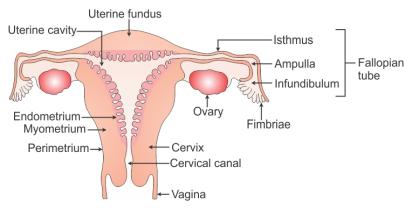
Q41. Draw a labelled diagram of
the reproductive system in a human female.
Solution
Reproductive system in a
human female
Q42. Given below is an incomplete flowchart showing the
influence of hormone on gametogenesis in males. Observe the flowchart
carefully and fill in the blank A, B, C and D.

Solution
A: Testosterone; B: Spermatogenesis; C: Sertoli
cells; D: Spermiogenesis
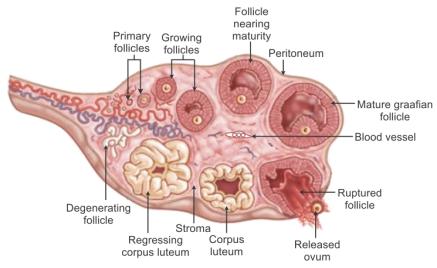
Q43. Draw a labelled diagram of longitudinal section of a
mammalian ovary.
Solution
Longitudinal section of a mammalian ovary
Q44. Three of the steps of neuro-endocrine mechanism in
respect of parturition are mentioned below.
Write the missing steps in proper sequence.
(a) Signals originate from fully developed foetus
and placenta.
(b) _____________.
(c) _____________.
(d) Oxytocin causes strong uterine contraction.
(e) Uterine contraction stimulates further secretion
of oxytocin.
(f) _____________.
Solution
(b) Foetal ejection reflex
(c) The reflex triggers release of oxytocin
(f) Expulsion of the baby out through the birth
canal.
Q45. How long do spermatozoa survive in the female
reproductive tract?
Solution
Spermatozoa once released into the female
reproductive tract can survive for about 1-3 days.
Q46. ICSH is secreted by
Solution
ICSH is secreted by the anterior pituitary.
Q47. Describe
the functions of human placenta.
Solution
Functions of human
placenta:
1.
Nutritive organ: Food materials pass from the mother’s blood into the foetal
blood through the placenta.
2.
Digestive organ: The trophoblast of the placenta digests proteins before
passing them into foetal blood.
3.
Respiratory organ: Oxygen diffuses from the maternal blood into foetal blood
through the placenta. Carbon dioxide diffuses from the foetal blood into the
maternal blood also through the placenta for elimination by the mother’s
lungs.
4.
Excretory organ: Nitrogenous wastes pass from the foetal blood into the
maternal blood through the placenta for elimination by mother’s kidneys.
5.
Endocrine organ: Placenta secretes (hCG), estrogen, progesterone and human
placental lactogen.
6.
Storage organ: The placenta stores glycogen for the foetus before liver is
formed.
7.
Barrier: Many substances pass from the mother to the foetus via placenta and
cause abnormal development in the developing foetus.
Q48. Name the muscular and the glandular layers of human uterus.
Which one of these layers undergoes cyclic changes during menstrual cycle?
Name the hormone essential for the maintenance of this layer.
Solution
(i)
The muscular layer of human uterus is called myometrium and the glandular
layer is called endometrium.
(ii)
Endometrium undergoes cyclic changes during the menstrual cycle.
(iii) Progesterone is essential for the maintenance of
endometrium.
Q49. Production of sperms requires low temperature. How
is it accomplished in the human body?
Solution
The testis descend below
the abdominal cavity at maturity in males. This helps in regulating
temperature which is necessary for the production of sperms.
Q50. What is meant by LH surge? Write the role of LH.
Solution
Rapid secretion of LH
leading to its maximum level during the mid-cycle is called LH surge. It
induces rupture of Graafian follicle and thereby the release of ovum
(ovulation).
Q51. Draw
a labelled diagram of the microscopic structure of a human sperm.
Solution
Microscopic structure of a
human sperm
Q52. Failure of testes to descend into scrotal sacs leads
to sterility. Why?
Solution
High temperature of the abdomen kills the spermatogenic
tissue of the testes. Thus, no sperms are formed. Hence, failure of testes to
descend into scrotal sacs leads to sterility.
Q53. Study the flow chart given below. Name the hormones
involved at each stage and explain their functions.
Hypothalamus
 Pituitary
Ovary
Pregnancy
Pituitary
Ovary
Pregnancy
Pituitary
Ovary
Pregnancy
Solution
Hypothalamus: Hypothalamus
releases gonadotrophin releasing hormone (GnRH) which stimulates the anterior
pituitary gland to secrete FSH, LH and progesterone.
Pituitary: Anterior pituitary gland secretes FSH to
stimulate the growth of Graafian follicle, maturation of ovum and secretion
of estrogen by follicle cells. It also secretes LH which stimulates release
of ovum, formation of corpus luteum in the empty follicle and secretion of
progesterone from the corpus luteum.
Ovary: The follicles in the ovary secrete estrogen
which brings about growth and maturation of the reproductive tract and
development of accessory sex characters.
Pregnancy: Progesterone suspends ovulation during
pregnancy, maintains foetal connection with the uterine wall and controls
development of foetus in the uterus. Estrogen and progesterone stimulate the
development of mammary glands during pregnancy.
Q54. Placenta
acts as an endocrine tissue. Justify
Solution
Placenta
secretes hormones such as human chorionic gonadotrophic (hCG), estrogen,
progesterone and human placental lactogen. So, placenta is regarded as an
endocrine tissue.
Q55. ‘Each and every coitus
does not result in fertilisation and pregnancy’. Justify the statement.
Solution
It is important that the
ovum and sperm reach simultaneously to the ampullary-isthmic junction. As
most of the sperms and ova fail to do so, each and every coitus does not
result in fertilisation and pregnancy.
Comments
Post a Comment