Q1. Pollen
grains of rice and wheat remain viable for
Solution
In
case of rice and wheat, the pollen grains remain viable for a very less time,
about 30 minutes.
Q2. “Incompatibility is a natural barrier in the
fusion of gametes”. Justify the statement.
Solution
1. Nature has developed
both structural as well as chemical barriers which restrict fertilisation in organisms.
2. Chemical
incompatibility of pollen prevents fertilisation
between unrelated plant species.
3. Structural barriers
like placement of anthers and stigma at different positions prevent self
pollination and promote cross pollination.
Q3. Starting
from the innermost part, the correct sequence of parts in an ovule are
Solution
The structure
of an ovule shows that eggs are the innermost part of the ovule followed by
the embryo sac, which contains the egg apparatus, followed by the nucellus, which is surrounded by integuments.
Q4. The nucleus in some seeds found on the outer side of
the endosperm is known as
Solution
Generally in seeds, the nucleus is used up. However,
in certain cases where it is not used up, it forms a thin layer on the
outside of the endosperm and is known as the perisperm.
Q5. Yucca
is pollinated by
Solution
Yucca
has a close obligatory symbiotic relation with its insect pollinator Tageticula (a moth).
Q6. Fusion of a male gamete with an egg in the embryo sac is called
Solution
One of the male gametes moves towards the egg cell and fuses with its nucleus thus completing syngamy.
Q7. Double
fertilisation involves
Solution
One of the
male gametes moves towards the egg cell and fuses with its nucleus thus
completing syngamy. This results in the formation of a diploid cell, the
zygote. The other male gamete moves towards the two polar nuclei located in
the central cell and fuses with them to produce a triploid primary endosperm
nucleus. This is called triple fusion. This completes the process of double
fertilisation.
Q8. When pollen is transferred from anther of a flower to stigma of another flower of the same plant, pollination is referred to
Solution
Allogamy is a type of sexual reproduction in plants in which pollen is transferred from one flower to the stigma of another. Xenogamy is the transfer of pollen grains from the anther to the stigma of a different plant. Siphonogamy is a condition in plants in which the pollen tubes are developed for the transfer of male cells to the egg.
Q9. Which
of the following plants does not show self-pollination?
Solution
Rye
shows cross-pollination, while the rest show self-pollination.
Q10. Explain
the process of artificial hybridisation to get
improved crop variety in:
(i) plants bearing bisexual flowers (ii) female parent producing
unisexual flowers.
Solution
If
a plant breeder desires to cross a particular plant with desired pollen
grains, a bisexual flower is artificially transformed into a female flower by
removing its stamens in bud condition without affecting the female
reproductive organs. This process is called emasculation.
The
emasculated flower is immediately enclosed in a bag to prevent pollination by
unwanted pollen. This process is called bagging. Then, mature and viable
pollen grains are collected from the male parent, the bag is opened and the
pollen grains are dusted on the stigma. The bag is replaced immediately.
The
technique of emasculation is applied only when artificial pollination is
carried out in a bisexual flower. If the female parent produces unisexual
flowers, emasculation is not needed. The unisexual flower is bagged before
the flowers open.
Q11. Even though each pollen grain has two male gametes,
why are at least 10 pollen grains and not 5 pollen grains required to
fertilise 10 ovules present in a particular carpel?
Solution
Even though each pollen grain has two male gametes,
atleast 10 pollen grains required to fertilise 10 ovules present in a
particular carpel instead of 5 pollen grains because only one male gamete is
involved in syngamy or the fusion of male gamete with the egg cell.
Q12. The
phenomenon wherein, the ovary develops into a fruit without fertilisation is called
Solution
Some plants
are able to produce fruits without fertilisation. This phenomenon is called
parthenocarpy.
Q13. Chiropterophily means
Solution
Pollination by
insects is called entomophily. Pollination by wind
is called anemophily. Pollination by snails is called malacophily.
Q14. The type of pollination that brings genetically different types of pollen grains to the stigma of a plant is
Solution
Geitonogamy is a kind of pollination in which pollen from the anther of a flower is transferred to the stigma of another flower borne on the same plant. Chasmogamous flower opens at maturity, exposing stamens and style to allow fertilisation. Autogamy is a kind of pollination in which pollen from the anther of a flower is transferred to the stigma of the same flower.
Q15. The
ovule found in Opuntia is of which
type?
Solution
The
circinotropous ovule is straight with the micropyle facing upwards. The
funicle is elongated and appears coiled shape and completely encircles the
ovule. In the beginning, the ovule is orthotropous, but it becomes circinotropous
as it develops. This type of ovule is seen in Opuntia flowers.
Q16. Parthenocarpic fruits are developed by the
application of
Solution
In horticultural techniques, parthenocarpic fruits
are artificially developed by the application of low concentration of auxins
and gibberellins.
Q17. In
Meiosis-I, the cells always divide along which plane?
Solution
In
Meiosis-I, the cells always divide along the transverse plane.
Q18. Funnel-shaped
corolla is an adaptation of which type of flowers?
Solution
Ornithophilous
flowers or flowers pollinated by birds have a funnel-shaped corolla to allow
access to the bird’s beak or tongue to reach to the nectarines.
Q19. The flowers
of brinjal are referred to as chasmogamous
while that of beans are cleistogamous. How are they
different from each other?
Solution
Flowers of brinjal are similar to flowers of other species where
anthers and stigma are exposed. Such flowers
are called chasmogamous flowers. On the other hand,
the flowers of beans remain closed to ensure self-pollination. Such flowers
which remain closed so that cross-pollination does not occur are called cleistogamous flowers.
Q20. Self-sterility implies
Solution
Self-sterility or self-incompatibility to mate with
members of the same species is known as self-sterility.
Q21. The
inner layer of the exine is
Solution
The
exine is made of two major layers—the outer sexine and the inner nexine. The
sexine is further divided into the outer tectum and the inner endosexine. The
nexine is made of the inner endexine and the outer foot layer.
Q22. (a)
Mention any four strategies adopted by flowering plants to prevent
self-pollination.
(b) Why is geitonogamy also referred
to as genetical autogamy?
Solution
(a)
Strategies adopted by flowering plants to prevent self-pollination:
1.
Herkogamy: Flowers possess some mechanical barrier
on their stigmatic surface to avoid self-pollination.
2.
Dichogamy: Pollen and stigma of the flower mature
at different times to avoid self-pollination.
3.
Self-incompatibility: In same plants, the mature pollen fall
on the receptive stigma of the same flower but fail to bring about
self-pollination.
4.
Male sterility: The pollen grains of some plants are not functional. Such
plants set seeds only after cross-pollination.
5.
Dioecism: Cross-pollination always occurs when the plants are unisexual and dioecious.
6.
Heterostyly: The flowers of some plants have
different lengths of stamens and styles so that self-pollination is not
possible.
(b)
Geitonogamy is also referred to as genetical autogamy because it
refers to the fusion of male and female gamete from genetically similar
plant.
Q23. One
flower of Cannabis produces how
many pollen grains?
Solution
A
single flower of Cannabis produces
about 500000 pollen grains.
Q24. In the sixteen-cell stage of the embryo in dicots,
the eight protodermal cells show which kind of division?
Solution
In the sixteen-cell stage of the embryo in dicots,
the eight protodermal cells divide further by anticlinal division to form the
embryonic surface layer, while the inner eight cells divide in different
planes to form the ground meristem and procambium.
Q25. Flowers
of Aristolochia smell of
Solution
Aristolochia is an
entomophilous flower and smells like decaying tobacco.
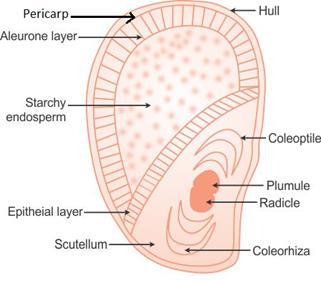
Q26. Draw a vertical section of
a maize grain and label
(i) pericarp (ii)
scutellum (iii) coleoptiIe and (iv)
radicle.
Solution
Vertical section of maize
grain
Q27. Wind pollination is common in
Solution
Wind pollination describes the process of the transfer of pollen from one individual plant to another, whereby the pollen is carried by air currents. This occurs mostly in grasses and gymnosperms.
Q28. Banana is a parthenocarpic fruit
whereas oranges show polyembryony. How are they different from
each other with respect to seeds?
Solution
Banana fruits are seedless. Such
fruits are called parthenocarpic, i.e., they produce embryo without fertilisation.
The seeds of oranges have many
embryos of different sizes and shapes. The orange seeds develop many embryos
due to polyembryony.
Q29. The
outermost layer of maize endosperm is known as
Solution
The aleurone layer is the outermost layer of the endosperm.
Perisperm, tapetum and endothecium form the inner layers of the maize grain.
Q30. The endosperm cells in angiosperms are
Solution
The primary endosperm nucleus divides and after many divisions fills the seed around the embryo with a triploid tissue called the endosperm.
Q31. Among the animals, insects particularly bees are the
dominant pollinating agents. List any four characteristic features of
insect-pollinated flowers.
Solution
Characteristic features of insect-pollinated
flowers:
1. Flowers are large.
2. Colourful petals of flower.
3. Presence of fragrance.
4. Rich in nectar.
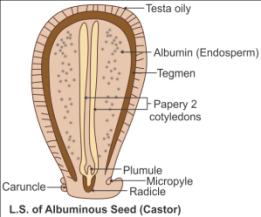
Q32. (a) Draw a labelled longitudinal view of an albuminous
seed.
(b) How are seeds advantageous to flowering plants?
Solution
(a) Longitudinal view of
an albuminous seed
 (b) Seeds contain food to
nourish the embryo during germination and possess better adaptive strategies
for dispersal to new habitats. These are formed by sexual reproduction with
new variations and better genetic combinations. So, the seeds advantageous to
flowering plants.
(b) Seeds contain food to
nourish the embryo during germination and possess better adaptive strategies
for dispersal to new habitats. These are formed by sexual reproduction with
new variations and better genetic combinations. So, the seeds advantageous to
flowering plants.
(b) Seeds contain food to
nourish the embryo during germination and possess better adaptive strategies
for dispersal to new habitats. These are formed by sexual reproduction with
new variations and better genetic combinations. So, the seeds advantageous to
flowering plants.
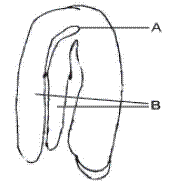
Q33. In the given figure of a dicot embryo, label the
parts (A) and (B) and give their functions.
Solution
A: Plumule
Function: To form the shoot system
B: Cotyledons
Function: Storage of food
Q34. Chalazogamy
can be observed in
Solution
When
the pollen tube enters the ovule through the chalazal end, it is known as chalazogamy. It is observed in Casuarina.
Q35. If the diploid number of chromosomes in an
angiospermic plant is 16, mention the number of chromosomes in the endosperm
and antipodal cell.
Solution
The
diploid (2n) number of chromosomes in an angiospermic plant is 16. So, the
number of chromosomes in endosperm (3n) is 24 and that in antipodal cells
(2n) is 16.
Q36. Name the type of flower which favours cross-pollination.
Solution
The
flowers which favour cross-pollination are chasmogamous flowers. They develop exposed anthers and
stigma.
Q37. Why is the process of fertilisation
in a flowering plant referred to as double fertilisation? Explain.
Solution
Fertilisation in flowering plants is referred to as double
fertilisation because both the male gametes of the
same microspore take part in fusion. One fuses with the egg to form the
diploid zygote, and the other fuses
with the two polar nuclei (or secondary nuclei) to form the triploid primary
endosperm nucleus.
Q38. Differentiate between geitonogamy
and xenogamy.
Solution
Difference
between geitonogamy and xenogamy
Geitonogamy
Xenogamy
Transfer
of pollen grains from the anther to the stigma of another flower of the same plant.
Transfer of pollen grains from the anther to the stigma
of the different plant.
Does
not provide an opportunity for gametic
recombination.
Provides an opportunity for gametic
recombination.
Q39. Indicate the stages where meiosis and
mitosis occur (1, 2 or 3) in the flowchart.

Solution
1. Meiosis
2. Mitosis
3. Mitosis
Q40. Mention two strategies evolved
to prevent self-pollination in flowers.
Solution
Cross-pollinating flowers
develop the following strategies to prevent self-pollination :
1. Protogyny
(when gynoecium matures earlier than androecium) or Protandry (when androecium matures and sheds pollen before maturation of gynoecium)
2. Self incompatibility
Q41. Trace
the development of microsporocyte in the anther to a mature pollen grain.
Solution
As
the anther develops, the cells of the sporogenous tissue undergo meiotic
divisions to form microspore tetrads. As each cell of the sporogenous tissue
is capable of giving rise to a microspore tetrad, each one is a potential
pollen or microspore mother cell. The process of formation of microspores
from a pollen mother cell (PMC) through meiosis is called microsporogenesis.
As the anthers mature and dehydrate, the microspores dissociate from each
other and develop into pollen grains. Inside each microsporangium, several
thousands of microspores or pollen grains are formed that are released with
the dehiscence of the anther.
Q42. a) Cleistogamous flowers are
strictly self pollinating”. Explain.
b) What is the
disadvantage of this phenomenon?
Solution
a) Cleistogamous flowers
do not open at all and therefore, fertilisation is
always between the gametes of the same flower.
b) Continued self pollination results in
inbreeding depression.
Q43. In
double fertilisation
Solution
One of the
male gametes moves towards the egg cell and fuses with its nucleus thus
completing syngamy. This results in the formation of a diploid cell, which is
the zygote. The other male gamete moves towards the two polar nuclei located
in the central cell and fuses with them to produce a triploid primary
endosperm nucleus. This completes the process of double fertilisation.
Q44. In
the embryo sac, how many nuclei differentiate to form the antipodal cells?
Solution
During
embryo sac development, four nuclei are found at the chalazal and micropylar
ends. Of the four nuclei at the chalazal end, three nuclei differentiate to
form the antipodal cells.
Q45. Give reasons why
(i) Most zygotes in angiosperms divide only after certain amount of endosperm is formed.
(ii) Groundnut seeds are exalbuminous and castor seeds are albuminous.
(iii) Micropyle remains as a small pore in the seed coat of a seed.
(iv) Integuments of an ovule harden and the water content is highly reduced as the seed matures.
(v) Apple and cashew are not called true fruits.
Solution
(i) Endosperm is the food laden tissue formed during the development of angiospermous seed which provides essential nutrients to the growing embryo and also the young seedling at the time of seed germination. So, most zygotes in angiosperms divide only after certain amount of endosperm is formed.
(ii) The seeds in which the endosperm is used up are called exalbuminous seeds. In groundnut, the endosperm is used and the reserve food material is stored in cotyledons. So, groundnut seeds are exalbuminous. The seeds having ample amount of endosperm tissue are called albuminous seeds. Castor seeds have persistent endosperm. So, castor seeds are albuminous.
(iii) Double fertilisation in angiosperms brings about some changes in the ovule during the development of seed. The micropyle remains in the form of a fine pore on the surface of seed to allow the entry of water during seed germination.
(iv) Integuments of an ovule harden and the water content is highly reduced as the seed matures to ensure the survival of seeds.
(v) The fruit derived from the ovary of a flower not associated with any non-carpellary part is called a true fruit. In apple and cashew, the main edible part of the fruit is the fleshy receptacle. So, they are not true fruits. Such fruits derived from the ovary along with other accessory floral parts are called false fruits.
Q46. Give the scientific name of a plant which came to
India as a contaminant with imported wheat and caused pollen allergy.
Solution
Parthenium, which
is a noxious weed, came to India as a contaminant with
imported wheat and caused pollen allergy.
Q47. Why are pollen grains produced in enormous quantity
in maize?
Solution
Pollen
grains are produced in enormous quantity in maize to ensure pollination as
maize is pollinated by wind.
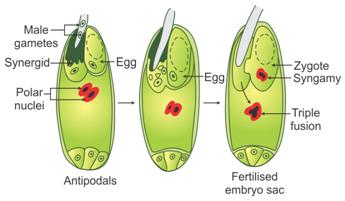
Q48. (a) Draw a schematic labelled diagram of a
fertilised embryo sac of an angiosperm.
Solution
(a) Fertilised embryo sac of an angiosperm
Q49. Mention the reasons for the difference in ploidy of zygote
and primary endosperm nucleus in an angiosperm.
Solution
Zygote is formed by
syngamy, so it is diploid in nature, and primary endosperm nucleus is formed
by the fusion of
secondary diploid nucleus with one of the male gamete, so it is triploid in
nature.
Q50. Continued self pollination leads to inbreeding
depression. List three devices which flowering plants have developed to
discourage self pollination?
Solution
Devices developed by flowering plants to discourage
self pollination are:
(a) Release of pollen and stigma receptivity is not
synchronised in some species
(b) Anther and stigma are at different
position/heights in some plants
(c) Self-incompatibility-a genetic mechanism
Q51. What will be the fate of the following structures in
an angiospermic plant?
Ovary wall, ovule, zygote, outer integument, inner
integument and primary endosperm nucleus.
Solution
Ovary wall: Pericarp
Ovule: Seed
Zygote: Embryo
Outer integument: Testa
Inner integument: Tegmen
Primary endosperm nucleus: Endosperm
Q52. Some
plants have a mechanism of shedding of pollen before the maturation of
stigma. Why?
Solution
Some
plants have a mechanism of shedding of pollen before the maturation of stigma to prevent self-pollination.
Q53. Differentiate between microsporogenesis and megasporogenesis.
What type of cell division occurs during these events? Name the structures
formed at the end of these two events.
Solution
Microsporogenesis: Process of formation of
microspore from the pollen mother cell.
Megasporogenesis: Process of formation of megaspore
from megaspore mother cell.
Meiotic division occurs in both the events.
Microsporogenesis results in the formation of pollen
grains, while megasporogenesis results in the formation of megaspores.
Q54. In a young anther, a group of compactly arranged
homogenous cells were observed in the centre of each microsporangium. What is
the name given to these cells?
Solution
Sporogenous tissue comprises of compactly arranged homogenous cells
observed in the centre of each microsporangium.
Q55. A
bilobed and dithecous anther has 100 microspore mother cells per
microsporangium. How many male gametophytes can it produce?
Solution
Each
microsporangium has 100 microspore mother cells which form 400 microspores by
meiosis (100 × 4).
In
an anther, there are four microsporangia. So, the total number of microspores
will be 4 × 400 = 1600.
As
each microspore forms one male gametophyte, 1600 male gametophytes can be
produced.
Q56. Draw a labelled diagram of
the sectional view of a mature pollen grain in angiosperms. Explain the
functions of its different parts.
Solution
Structure of mature
pollen grains in angiosperms.
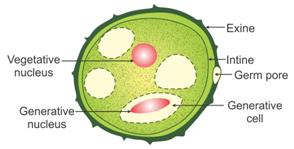 Functions of the parts of
pollen grain: A mature pollen grain has a two-layered wall—the outer exine
and inner intine. The wall encloses a large vegetative cell containing
vegetative nucleus and a lenticular generative cell. Their functions are as
follows:
1. Exine: The outer thick
exine layer is made up of sporopollenin which is resistant to physical and
biological decomposition. It provides protection during the hazardous journey
of pollen from the anther to stigma. There are one or many germ pores on the
pollen surface which are directly or indirectly associated with its
germination.
2. Intine: The intine is
pecto-cellulosic in nature. It is associated with the formation of the pollen
tube.
3. Vegetative cell: The
vegetative cell is large and contains abundant food reserve. It has a large
vegetative nucleus.
The function of the vegetative cell is to provide the medium for the movement
of male gametes inside the pollen tube.
4. Generative cell: The generative
cell cytoplasm is highly reduced but it contains the usual cell organelles.
It
divides mitotically to produce two functional male gametes.
Functions of the parts of
pollen grain: A mature pollen grain has a two-layered wall—the outer exine
and inner intine. The wall encloses a large vegetative cell containing
vegetative nucleus and a lenticular generative cell. Their functions are as
follows:
1. Exine: The outer thick
exine layer is made up of sporopollenin which is resistant to physical and
biological decomposition. It provides protection during the hazardous journey
of pollen from the anther to stigma. There are one or many germ pores on the
pollen surface which are directly or indirectly associated with its
germination.
2. Intine: The intine is
pecto-cellulosic in nature. It is associated with the formation of the pollen
tube.
3. Vegetative cell: The
vegetative cell is large and contains abundant food reserve. It has a large
vegetative nucleus.
The function of the vegetative cell is to provide the medium for the movement
of male gametes inside the pollen tube.
4. Generative cell: The generative
cell cytoplasm is highly reduced but it contains the usual cell organelles.
It
divides mitotically to produce two functional male gametes.
Functions of the parts of
pollen grain: A mature pollen grain has a two-layered wall—the outer exine
and inner intine. The wall encloses a large vegetative cell containing
vegetative nucleus and a lenticular generative cell. Their functions are as
follows:
1. Exine: The outer thick
exine layer is made up of sporopollenin which is resistant to physical and
biological decomposition. It provides protection during the hazardous journey
of pollen from the anther to stigma. There are one or many germ pores on the
pollen surface which are directly or indirectly associated with its
germination.
2. Intine: The intine is
pecto-cellulosic in nature. It is associated with the formation of the pollen
tube.
3. Vegetative cell: The
vegetative cell is large and contains abundant food reserve. It has a large
vegetative nucleus.
The function of the vegetative cell is to provide the medium for the movement
of male gametes inside the pollen tube.
4. Generative cell: The generative
cell cytoplasm is highly reduced but it contains the usual cell organelles.
It
divides mitotically to produce two functional male gametes.
Q57. (a) Draw the embryo sac of a flowering plant and
label:
(i) Central cell.
(ii) Chalazal end.
(iii) Synergids.
(b) Name the cell that develops into an embryo sac
and explain how this cell leads to the formation of embryo sac.
(c) Mention the role played by the various cells of the
embryo sac.
(d) Give the role of filiform apparatus.
Solution
(a) Embryo sac of a flowering plant.
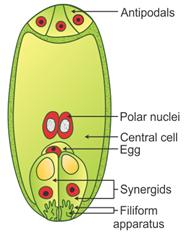 (b) Functional megaspore.
The nucleus of the functional megaspore divides
mitotically to form two nuclei which move to opposite poles and form the
2-nucleate embryo sac.
(c) Egg: Fuses with the male gamete to form zygote
or the future embryo.
Synergid: Absorption of nutrients, attracts and
guides the pollen tube.
Central cell: After fusion with the second male
gamete, it forms the primary endosperm cell which gives rise to the endosperm.
(d) The filiform apparatus guides the entry of
pollen tube into the embryo sac.
(b) Functional megaspore.
The nucleus of the functional megaspore divides
mitotically to form two nuclei which move to opposite poles and form the
2-nucleate embryo sac.
(c) Egg: Fuses with the male gamete to form zygote
or the future embryo.
Synergid: Absorption of nutrients, attracts and
guides the pollen tube.
Central cell: After fusion with the second male
gamete, it forms the primary endosperm cell which gives rise to the endosperm.
(d) The filiform apparatus guides the entry of
pollen tube into the embryo sac.
(b) Functional megaspore.
The nucleus of the functional megaspore divides
mitotically to form two nuclei which move to opposite poles and form the
2-nucleate embryo sac.
(c) Egg: Fuses with the male gamete to form zygote
or the future embryo.
Synergid: Absorption of nutrients, attracts and
guides the pollen tube.
Central cell: After fusion with the second male
gamete, it forms the primary endosperm cell which gives rise to the endosperm.
(d) The filiform apparatus guides the entry of
pollen tube into the embryo sac.
Comments
Post a Comment