Q1. Strontium-90
accumulates in the
Solution
Strontium-90
accumulates in the bone and may cause bone cancer.
Q2. The figure below shows the relative contribution of
four greenhouse gases to global warming.
 (i)
Identify the gases A and C.
(ii) Why are these four gases called greenhouse
gases?
(i)
Identify the gases A and C.
(ii) Why are these four gases called greenhouse
gases?
(i)
Identify the gases A and C.
(ii) Why are these four gases called greenhouse
gases?Solution
(i) A
recent survey has revealed 60%, 20%, 14% and 6% of warming effect of CO2,
CH4, CFCs and N2O. So, according to the figure, Gas A
is carbon dioxide (C02) and Gas C is chlorofluorocarbon (CFC).
(ii) These gases in the
atmosphere are transparent to sunlight but can trap heat and keep the Earth’s
surface warm. They are responsible
for the greenhouse effect and are therefore called greenhouse gases.
Q3. The
term biomagnification refers to the
Solution
An
increase in the concentration of toxic materials at each trophic level of a
food chain is called biomagnification or biological magnification.
Q4. Oysters
are used for the accumulation of which radioactive material?
Solution
Certain
organisms can take up radioactive materials and accumulate them without facing
any danger. Oysters can accumulate 65Zn.
Q5. How is snow
blindness caused in humans?
Solution
The cornea of the human eye
absorbs UV-B radiation. High dose of UV-B can cause inflammation of the cornea
called snow blindness. Such exposure may permanently damage the cornea.
Q6. The pH of acid rain is below
Solution
Acid rain is precipitation with a pH less than 5. It is a mixture of H2SO4 and HNO3. Acid rain occurs due to sulphur dioxide and nitrogen oxide produced by the combustion of fossil fuels, industries, power plants etc.
Q7. In
radioactivity, beta particles are
Solution
In
radioactivity, beta particles are electrons and alpha particles are
protons.
Q8. Which
of the following accounts for more than 50% of air pollutants?
Solution
Carbon
monoxide accounts for more than 50% of the air pollutants.
Q9. The Montreal protocol which calls for appropriate action to protect the ozone layer from human activities was passed in the year
Solution
On 16th September 1987, twenty-seven industrialised countries signed an agreement called the Montreal Protocol to limit the production and use of ozone-depleting substances like chlorofluorocarbons (CFCs) and to implement the use of alternatives to CFCs.
Q10. In
India, Van Mahotsava is held during
Solution
In
India, Van Mahotsava is a festival during which plants are planted. It is
held in February and July since 1950.
Q11. Which of the following is a secondary pollutant?
Solution
Secondary pollutants are formed by the interaction with primary pollutants. PAN or peroxyacyl nitrate is a secondary pollutant, while NO, NO2 and SO2 are examples of primary pollutants.
Q12. Atomic
weapons use
Solution
Atomic
weapons use uranium-235 and plutonium-239.
Q13. Which of the following is not a greenhouse gas?
Solution
The increase in mean global temperature of the Earth due to increased concentration of greenhouse gases like carbon dioxide (CO2), methane (CH4), chlorofluorocarbons (CFCs) and nitrous oxide (N2O) is called the greenhouse effect.
Q14. Carbon dioxide is called a greenhouse gas because it is
Solution
The greenhouse gases in the atmosphere are transparent to sunlight but can trap heat and keep the Earth’s surface warm. These gases include CO2, CH4, CFCs and N2O. They are called radiatively active gases as they can absorb long wave infrared radiation.
Q15. IPCC
regularly assesses the concentrations of greenhouse gases and studies its
impact on global warming. According to recent surveys, which gas contributes
maximum towards the warming effect?
Solution
According
to a recent survey by the IPCC, CO2 contributes to about 60% of
the total warming in greenhouse effect.
Q16. The
ozone is thickest at the
Solution
The
ozone is thickest at the poles and thinnest at the equator.
Q17. PCBs
are a class of chemicals which cause water pollution. Expand PCBs.
Solution
PCBs
are polychlorinated biphenyls.
Q18. Expand
PAN.
Solution
PAN
- Peroxyacyl nitrate is a type of photochemical oxidant.
Q19. Byssinosis is caused
by
Solution
Asbestos
causes asbestosis.
Stone
particles cause silicosis.
Cotton
fibres cause byssinosis.
Dust
particles cause lung fibrosis or pneumoconiosis.
Q20. On
a global scale, which country has the highest loss of top soil?
Solution
On
a global scale, the loss of top soil is maximum (about 18.5%) in India.
Q21. What is meant by Jhum cultivation? Explain how it is
responsible for deforestation.
Solution
In Jhum cultivation, farmers clear the trees of the
forest area and burn the plant remains. The ash of the burnt vegetation
contains minerals and is used as fertiliser. The land is then used for
farming or cattle grazing. After cultivation, the farmers move to another
area and this process is repeated. This practice has caused major
deforestation in north eastern states of India.
Q22. Which
of the following pollutants reduces the oxygen-carrying capacity of blood in
humans?
Solution
Carbon
monoxide binds to haemoglobin and reduces the oxygen-carrying capacity of
blood.
Q23. The Chipko movement was launched for the protection of
Solution
The Chipko Movement was started in 1973 at Gopeshwar town of Chamoli
district to check the felling of trees by contractors. The peasant women of
Reni village protested by embracing the trees to prevent them from being
felled.
Q24. The
Earth Summit was held at
Solution
The
Earth Summit was held at Rio de Janeiro,
Brazil, in 1992.
Q25. Checking of reradiating heat by atmospheric dust, O3, CO2 and water vapour is called
Solution
The atmospheric cover of the Earth acts like glass walls of a greenhouse. It absorbs most of the incoming solar radiations from the Sun and reradiates them to the Earth’s surface. However, it prevents the long wave infrared radiation emitted by the Earth’s surface to escape into space. In this way, the atmosphere acts as a greenhouse, trapping the heat.
Q26. State the
major causes of air pollution in metro cities. Write any three ways in which
it can be reduced.
Solution
The major
causes of air pollution in metro cities are
(i) Smoke
from forest fires, volcanic eruptions etc.
(ii)
Decomposition of garbage resulting in the release of unwanted gases into the
atmosphere.
(iii)
Burning of fossil fuels in automobiles and industries release particulate air
pollutants.
(iv) Use of
unleaded petrol.
(v) Gaseous
waste or particulate by-products of various industries.
Control measures
of air pollution:
(i) Use of
electrostatic precipitators to remove particulate matter from industries and
thermal power plants.
(ii) Use of
scrubber to remove gases like S02.
(iii) Use of catalytic converters in automobiles to reduce
the emission of poisonous gases.
Q27. Allethrin is a
Solution
Allethrins are a group of synthetic compounds used in insecticides. They are synthetic pyrethroids which are found naturally in the Chrysanthemum flower.
Q28. Why are
lichens regarded as pollution indicators?
Solution
Lichens are
regarded as pollution indicators because they are sensitive to sulphur
dioxide (SO2) and do not grow
in polluted areas. Their presence indicates the absence of pollution in an area,
and their absence indicates that the area is polluted.
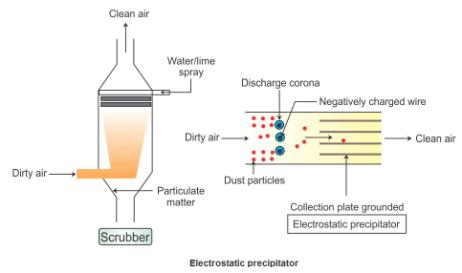
Q29. Describe
electrostatic precipitator by a diagram.
Solution
Electrostatic
precipitators are extremely efficient devices which remove about 99% of
particulate matter present in the industrial and thermal power exhausts. They
have charged plates which are connected to the ground. The electrode wires
are provided with high voltage electric current which produce a corona that
releases electrons. These electrons attach to the dust particles giving them
a negative charge. The collecting particles are grounded and attract the
charged dust particles. The velocity of air between the plates must be low
enough to allow the dust to fall.
Q30. Greenhouse
gases are capable of absorbing
Solution
Greenhouse
gases are capable of absorbing long wave infrared radiation and hence are
also known as radiatively active gases.
Q31. What is
integrated organic farming?
Solution
Integrated organic farming is a cyclical, zero-waste
procedure, where waste products from one process are cycled in as nutrients
for other processes.
Q32. What is an ozone shield?
Solution
The thin layer of ozone which surrounds the Earth’s atmosphere and prevents harmful UV rays from reaching the Earth’s surface is called the ozone shield.
Q33. Why is Eichhornia crassipes regarded as ‘Terror of Bengal’?
Solution
Eichhornia crassipes is an aquatic weed which grows fast and abundantly in water bodies with excess of nutrients and causes an imbalance in the water ecosystem. It results in oxygen depletion causing eutrophication, leading to the death of aquatic life.
Q34. Pollution from animal excreta and organic waste from the kitchen can be most profitably minimised by
Solution
Biodegradable wastes like animal excreta and organic waste from the kitchen can be used in biogas plants to generate biogas and manure. Biogas is a cheap source of fuel and the manure can be used as a cheap fertiliser.
Q35. What is
reforestation?
Solution
Reforestation
is the process of restoring a forest which once existed but was removed at some
point of time in the past.
Q36. (a) What
depletes ozone in the stratosphere? How does this affect human life?
(b) Explain
biomagnification of DDT in an aquatic food chain. How does it affect the bird
population?
Solution
(a)
Chlorofluorocarbons (CFCs) are mainly responsible for the depletion of ozone
in the stratosphere. Once released in the troposphere, CFCs reach the stratosphere and
produce ‘active chlorine’ in the presence of ultraviolet (UV) radiation. These
radicals, through a chain reaction, destroy the ozone by converting it into
oxygen. Excess dose of UV-B
radiations damages DNA causing mutation, skin cancer, snow blindness,
cataract and ageing of skin.
(b) If DDT
leaches from agricultural fields, it enters the nearby water body. The concentration
of DDT in the water body is low (0.003 ppm). The pesticide enters the food
chain and gets accumulated in zooplankton (0.04 ppm) and thereby its
concentration goes on increasing at different trophic levels of the food
chain from the small fish (0.5 ppm), large fish (2 ppm) to finally the fish-eating
birds (5 ppm). Concentration of DDT increases along the food chain, reaching the
highest level in the top carnivore bird. The increased concentration of DDT
in birds disturbs calcium metabolism. The egg shells become thin, resulting
in premature breaking. Consequently, there is a decline in the bird
population.
Q37. Study the
graph given below and answer the questions which follow:
 (i) What is
the relationship between dissolved oxygen and biochemical oxygen (BOD)?
(ii)
Mention their effect on aquatic life in the river.
(i) What is
the relationship between dissolved oxygen and biochemical oxygen (BOD)?
(ii)
Mention their effect on aquatic life in the river.
(i) What is
the relationship between dissolved oxygen and biochemical oxygen (BOD)?
(ii)
Mention their effect on aquatic life in the river.Solution
(i) BOD
refers to the amount of oxygen required to decompose the organic matter
present in one litre of water. Thus, greater the BOD, lesser will be the dissolved
oxygen content in sewage discharge.
(ii)
Effects on aquatic life:
(a) It
causes high mortality of aquatic animals.
(b) The
excessive nutrients facilitate algal growth causing algal bloom.
Q38. What was the purpose of the concept of Joint Forest Management (JFM)?
Solution
The Government of India in 1980s introduced the concept of Joint Forest Management (JFM) so as to work closely with the local communities for the protection and management of forests. In return, the communities got the benefit of various forest products such as fruits, gum, rubber, medicine etc. In this way, the forest can be conserved in a sustainable manner.
Q39. Write about
the 3R technology in waste management.
Solution
We can follow the 3R approach - reduce, reuse and
recycle - for effective waste management.
Reduce: One can reduce the amount of solid waste at
the source itself. Example: Use of less paper and less plastic
carry bags.
Reuse: One
can use plastic bottles and jars, aluminium foils and plastic bags over and
over again, before recycling or disposing them of.
Recycle:
Used and discarded materials like plastic, glass, paper and metal are sent to
the respective industries, where they can be converted into other useful
products.
Q40. Mention how
e-waste is produced and disposed of. Write the solution for its treatment.
Solution
Discarded electrical appliances such as old
television sets, computers, radios, mobile phones, fluorescent tubes, medical
instruments, toys and lead acid batteries all fall into the category of
e-wastes. E-wastes are either buried
in landfills or incinerated. Recycling under skilled supervision is the only
solution for the treatment of e-wastes.
Q41. Write the differences between BOD and COD.
Solution
Differences between BOD and COD
BOD
COD
1. BOD refers to Biochemical Oxygen Demand.
1. COD refers to Chemical Oxygen Demand.
2. BOD is the oxygen required for the decomposition of unit mass of organic matter by microbes.
2. COD is the oxygen required for the chemical oxidation of unit mass of reduced organic and inorganic matter.
3. It is comparatively lower.
3. It is comparatively higher.
4. Involves only aerobic decomposer microbes.
4. Involves chemical oxidants.
Comments
Post a Comment