Q1. The
most recent definition for biotechnology was given by
Solution
The
most recent definition for biotechnology was given by the European Federation
of Biotechnology. The definition states that biotechnology is the integrated
use of biochemistry, microbiology and engineering sciences in order to
achieve technological application of the capabilities of microorganisms,
cultured tissue/cells and parts thereof.
Q2. Gel electrophoresis is
used for
Solution
Gel electrophoresis is a
technique used for the separation of substances of different ionic
properties. During electrophoresis, DNA fragments move towards the anode
according to their molecular size through the agarose
gel.
Q3. The
first restriction endonuclease was isolated by
Solution
The
first restriction endonuclease was isolated by Arber, Nathan and Smith from
the bacterium Haemophilus
parainfluenzae.
Q4. Two microbes found to be very useful in genetic engineering are
Solution
Escherichia coli possesses plasmid which encodes genes that may act as selectable markers in transformations. Agrobacterium tumefaciens possesses Ti plasmid that induces tumour formation. These have been used as vectors to transfer foreign genes of interest into the target animal and plant cells.
Q5. For transformation, micro-particles coated with DNA to be bombarded with gene gun are made up of :
Solution
The technique of shooting foreign DNA into plant cells at a very high velocity is called biolistics. In this method, 1-2 m gold or tungsten particles coated with DNA are shooted into the plant cells using a helium pressure particle gun device.
m gold or tungsten particles coated with DNA are shooted into the plant cells using a helium pressure particle gun device.
Q6. Restriction endonuclease
Solution
Restriction endonucleases inspect the DNA molecule in search of
specific recognition sequence. Once it gets its specific recognition
sequence, it binds to the site and cuts each of the two strands of the double
helix at specific points by hydrolyzing the phosphodiester
bond.
Q7. Taq polymerase is isolated from
Solution
Taq DNA polymerase is isolated
from the thermophilus bacteria Thermus aquaticus.
Q8. Stanley
and Herbert isolated the antibiotic-resistant gene from the plasmid of
Solution
Stanley
and Herbert isolated the antibiotic-resistant gene from the plasmid of the
bacterium Salmonella typhimurium.
Q9. Who discovered recombinant DNA (rDNA) technology?
Solution
Herbert Boyer and Stanley Cohen combined their efforts in biotechnology to invent the rDNA technology method of cloning genetically engineered molecules in foreign cells.
Har Gobind Khorana research helped to show how the order of nucleotides in nucleic acids, which carry the genetic code of the cell, control the cell’s synthesis of proteins.
James D. Watson is best known as a co-discoverer of the structure of DNA in 1953 with Francis Crick.
Walter Sutton and Avery proposed that chromosomes bear hereditary factors.
Q10. Use of biology in industrial process and for improving quality of life is called:
Solution
Use of biology in industrial process and for improving quality of life is called biotechnology.
Microbiology is the study of microscopic organisms.
Genetic engineering is the direct manipulation of an organism's genome using biotechnology.
Eugenics is the belief and practice of improving the genetic quality of human population.
Q11. A bioreactor is:
Solution
Bioreactors are large vessels with a capacity of 100 to 1000 litres, which are used for biological conversion of raw materials into specific products. Each bioreactor has a cylindrical stirred tank to facilitate the mixing of contents. It has an agitator system to mix the contents properly, an oxygen delivery system to make availability of oxygen, a foam control system, a temperature control system, a pH control system and a sampling port to withdraw small volumes of the culture periodically.
Q12. The
process of extension requires which of the following ions?
Solution
The
process of extension in PCR requires the presence of Taq DNA polymerase, deoxynucleoside triphosphate and Mg2+.
Q13. Who
is regarded as the ‘father of genetic engineering’?
Solution
Paul
Berg was the first to successfully introduce a gene (SV-40) into a bacterium
with the help of a lambda phage, and hence, he is regarded as the ‘father of
genetic engineering’.
Q14. The ability of a cell to
grow into a complete plant is called:
Solution
Cellular totipotency is
the ability of a single cell to divide and produce all the differentiated
cells in an organism.
Somaclonal variation is
the variation seen in plants that have been produced by plant tissue culture.
Protoplast fusion is a type
of genetic modification in plants by which two distinct species of
plants are fused together to form a new hybrid plant with the
characteristics of both.
Tissue culture is a process
that involves exposing plant tissue to a specific regimen of nutrients,
hormones and light under sterile, in vitro conditions to produce many new
plants, each of which is a clone of the original mother plant, over a very
short period of time.
Q15. One of the key factors, which makes plasmid the vector in genetic engineering is that
Solution
Plasmids are small, double stranded, closed circular symbiotic DNA molecules that occur naturally in bacteria outside the bacterial chromosome. They have the capability to self-replicate in the cytoplasm of the bacterial cell and are used as carriers for transferring a fragment of foreign DNA into a suitable host.
Q16. In
the process of electroporation, the application of electric current causes
Solution
In
the process of electroporation, the application of electric current increases
the porosity of protoplasts. This causes the cell to easily take up the
foreign DNA present in the outside of the cell.
Q17. Who developed the technique of
electrophoresis? State its principle.
Solution
Electrophoresis was developed by
Tiselius in 1937 as a method for the separation of substances with different
ionic properties. It is based on the principle that charged particles move
under the influence of electric current to oppositely charged electrodes.
Q18. The
temperature required for the process of annealing is carried out at a temperature
of
Solution
In
PCR, annealing is the second step. In this process, the denatured DNA strands
are hybridised to the DNA primers. The step is carried out at 40-60°C.
Q19. The
bonds which are broken down during the denaturation
step of PCR are
Solution
In
the denaturation step of PCR, the two strands of
the DNA molecule are split apart. Because the two strands are held together
by hydrogen bonds between the complementary nitrogen bases on each strand,
hydrogen bonds are broken down during this step.
Q20. The polymerase chain
reaction is a technique that
Solution
Polymerase chain reaction is
based on the principle that a DNA molecule, when subjected to high
temperature, splits into two strands due to denaturation. These single
stranded molecules are then converted to original double stranded molecules
by synthesizing new strands in presence of enzyme DNA polymerase.
Q21. Who among the following was awarded the Nobel Prize for the development of PCR technique?
Solution
Herbert W. Boyer discovered a method to coax bacteria into producing foreign proteins, thereby jump starting the field of genetic engineering.
Har Gobind Khorana research helped to show how the order of nucleotides in nucleic acids, which carry the genetic code of the cell, control the cell’s synthesis of proteins.
Arthur Kornberg was the first scientist to identify deoxyribonucleic acid (DNA) polymerase in the intestinal bacterium E coli.
Kary Mullis received a Nobel Prize in Chemistry in 1993 for his invention of the Polymerase Chain Reaction (PCR).
Q22. How and why is bacterium Thermus aquaticus employed in
recombinant DNA technology? Explain.
Solution
DNA polymerase is obtained from the bacterium, Thermus aquaticus.
(i) DNA polymerase obtained from
this organism (Taq DNA polymerase)
is thermostable and remains active during high temperature applied during the
denaturation of double-stranded DNA.
(ii) This enzyme extends the
primers using nucleotides provided in the reaction and the genomic DNA as
template.
(iii) The repeated amplification is
achieved by this enzyme and the amplified fragment, if desired can be used to
ligate with a vector for further cloning.
Q23. State the uses of cloning vector in
biotechnology.
Solution
Cloning vectors are used for
transferring fragments of foreign DNA into a suitable host. They play an
important role in selecting recombinants from non-recombinants.
Q24. Which
enzyme is used to dissolve fungal cell walls?
Solution
The
chief component of the fungal cell wall is chitin. Hence, chitinase
is used for dissolving the fungal cell wall.
Q25. Explain the importance of (a) ori, (b) ampR and (c) rop in the E. coli vector shown below:

Solution
(a) ori: Ori or origin of replication is a specific
portion of plasmid genome that serves as a start signal for self-replication.
Any piece of DNA when linked to this sequence can be made to replicate within
the host cells. It is also responsible for controlling the copy number of the
linked DNA.
(b) ampR: The ligation of foreign DNA is carried out at a
restriction site present in any antibiotic resistance gene. It acts as a
selectable marker during transformation.
(c) rop:
It codes for the proteins involved in the replication of the plasmid.
Q26. Explain any two methods of
vectorless gene transfer.
Solution
The
two methods of vectorless gene transfer are as shown below:
(i)
Microinjection: The technique of introducing foreign DNA into a target cell
by injecting the DNA directly into the nucleus with the help of a
micro-needle is called micro-injection.
(ii)
Electroporation: The process in which transient holes are produced in the
plasma membrane of the target cell to incorporate foreign DNA is called
electroporation.
Q27. Agarose extracted from sea weeds
is used in
Solution
Agarose is the most commonly used
matrix in gel electrophoresis. It is a polysaccharide extracted from sea
weeds. DNA fragments move towards the anode according to their molecular size
through the agarose gel.
Q28. Why is enzyme cellulase used for
isolating genetic material from plant cells but not from animal cells?
Solution
Plant cells have cellulose in their
cell wall which can be degraded using the enzyme cellulase for isolating the genetic
material DNA. On the other hand, animal cell wall does not contain cellulose.
Hence, cellulase is not required for isolating DNA.
Q29. What are recombinant proteins? How do
bioreactors help in their production?
Solution
The protein produced by genetically altered DNA
(recombinant DNA) in a heterologous host is called recombinant protein. Bioreactors
are vessels in which raw materials are biologically converted into specific products
by microbes. It provides optimum growth conditions such as temperature, pH, substrate,
vitamins, oxygen and salts for the production of recombinant proteins.
Q30. What is a cloning vector? Explain the technique
of using such a vector in E.coli.
Solution
Cloning vectors are DNA molecules used
as carriers for transferring a fragment of foreign DNA and capable of replicating
inside the host cell independent of the control of chromosomal DNA. Plasmids and
bacteriophages are commonly used cloning vectors.
The technique of using cloning
vector in E. coli is as follows:
(i) The foreign DNA is linked to
the sequence called ori (origin of replication) and is made to replicate
within the host cell.
(ii) The ligation of foreign DNA is
carried out at a restriction site present in the resistance genes.
(iii) The foreign DNA is then
attached to the plasmid DNA (vector) with the help of enzyme ligase.
(iv) This recombinant DNA (rDNA) is
inserted into the bacterial cell where it multiplies to produce multiple
copies of the desired gene.
Q31. (a)
What are molecular scissors? Give one example.
(b)
Explain their role in recombinant DNA technology.
Solution
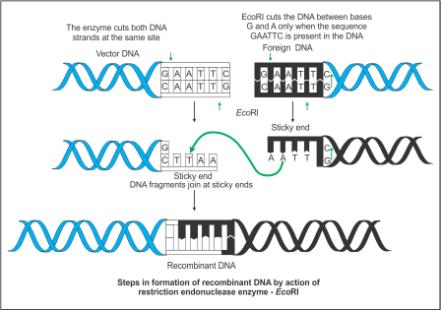
(a) Restriction endonucleases are
called molecular scissors as they cut the DNA segments at particular
locations. Example: EcoRI.
(b) Restriction enzymes cut the DNA
strands some distance away from the centre of the palindromic sites, but
between the same two bases on the opposite strands. This leaves single
stranded portions with overhanging stretches called sticky ends on each
strand as they form hydrogen bonds with their complementary cut counterparts.
This stickiness at the ends of DNA fragments facilitates the action of enzyme
DNA ligase.
Q32. How is DNA isolated in purified form from a bacterial cell?
Solution
DNA, the genetic material of bacteria is isolated in purified form by treating the bacterial cells with enzyme, lysozyme to dissolve the cell wall. The RNA can be removed by treating them with enzyme, ribonuclease and proteins can be removed by treatment with enzyme protease which converts proteins to amino acids. Finally, chilled ethanol is added to precipitate the purified DNA.
Q33. What is a bioreactor?
Solution
Bioreactors are large cylindrical vessels of
about 100-1000 litres in volume, which are used for biological conversion of
raw materials into specific products.
Q34. What is genetic engineering? List the steps involved
in rDNA technology.
Solution
Genetic
engineering involves techniques to alter the chemistry of genetic material
(DNA and RNA), to introduce these into host organisms and thus, change the
phenotype of the host organism.
Steps
in rDNA technology:
(i)
Isolation of DNA
(ii)
Fragmentation of DNA by restriction endonucleases
(iii)
Isolation of the desired DNA fragments
(iv)
Amplification of gene of interest
(v)
Ligation of the DNA fragment into a vector using DNA ligase
(vi)
Transfer of recombinant DNA into the host organism
(vii)
Culturing the host cell on a suitable medium on a large scale
(viii)
Extraction of the desired product
(ix)
Downstream processing of the products as finished products are ready for
marketing
Q35. How can DNA segments be separated by gel electrophoresis,
visualised and isolated?
Solution
As pure DNA fragments cannot be
seen under visible light, they can be visualised only after staining them
with a solution of ethidium bromide followed by exposure to UV radiation. They
appear as bright orange coloured bands. The separated bands of DNA are then cut
from the agarose gel and extracted by using a convenient technique. This
process is called elution. The eluted DNA fragments are then purified and used
in constructing recombinant DNA by joining them with cloning vectors.
Q36. How is the amplification of a gene sample of
interest carried out using Polymerase Chain Reaction (PCR)?
Solution
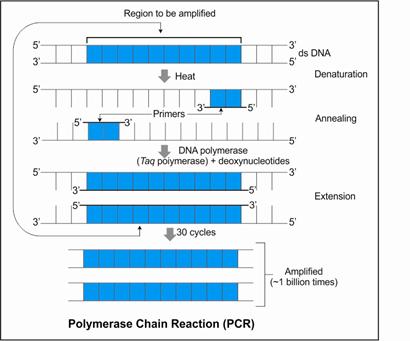
Polymerase Chain Reaction (PCR) is
a technique used to synthesize multiple copies of the desired gene in vitro
within a short span of time.
Amplification of a gene sample of
interest is carried out using PCR in the following three steps:
(a) Denaturation: The double
stranded DNA is denatured by applying high temperature of about 95 C for 15 seconds. Each separated single stranded
strand now acts as template for the synthesis of new DNA strand.
(b) Annealing: Two sets of primers
are added which anneal at the 3’ end of each separated strand. They mark the
beginning of replication.
(c) Extension: A thermostable DNA
polymerase, Taq polymerase extends
the primers by adding nucleotides complementary to the template provided in
the reaction.
The cycle of denaturation, annealing
and extension is repeated several times to obtain several copies of desired
DNA.
C for 15 seconds. Each separated single stranded
strand now acts as template for the synthesis of new DNA strand.
(b) Annealing: Two sets of primers
are added which anneal at the 3’ end of each separated strand. They mark the
beginning of replication.
(c) Extension: A thermostable DNA
polymerase, Taq polymerase extends
the primers by adding nucleotides complementary to the template provided in
the reaction.
The cycle of denaturation, annealing
and extension is repeated several times to obtain several copies of desired
DNA.
C for 15 seconds. Each separated single stranded
strand now acts as template for the synthesis of new DNA strand.
(b) Annealing: Two sets of primers
are added which anneal at the 3’ end of each separated strand. They mark the
beginning of replication.
(c) Extension: A thermostable DNA
polymerase, Taq polymerase extends
the primers by adding nucleotides complementary to the template provided in
the reaction.
The cycle of denaturation, annealing
and extension is repeated several times to obtain several copies of desired
DNA.
Comments
Post a Comment