Q1. Rotenone
is a
Solution
Rotenone
is obtained from the roots of Derris elliptica. It has insecticidal properties and is used
as a natural insecticide.
Q2. Bacillus
thuringiensis
(Bt) strains have been used for designing novel
Solution
The bacterium Bacillus thuringiensis (Bt) strains
contains genes for insecticidal crystal proteins. These have been isolated
from the bacteria and incorporated into the genetic material of various crop
plants through recombinant DNA technology. Bt-cotton is one such example of
bio-insecticidal plant.
Q3. Which
of the following is a product of yeast fermentation?
Solution
Some
of the products obtained from yeast fermentation are ethanol, caproic acid,
lactic acid, n-propanol,
glycerol, butanol and acetaldehyde.
Q4. Alexander
Fleming is associated with
Solution
Alexander
Fleming discovered the antibiotic penicillin and explored its possible
therapeutic use.
Q5. Milk begins to coagulate when lactic acid bacteria (LAB) are added to warm milk as a starter. Mention any other two benefits that LAB provide.
Solution
Other benefits of LAB:
(i) Increase the nutritional quality of curd by increasing vitamin B12 content
(ii) Inhibit the growth of disease-causing microbes in the gut
Q6. The
major component of biogas is
Solution
Methane
is the major component of biogas, consisting of about 50-68% of the total gas.
Q7. Which one of the following microbes is used in the commercial production of ethanol?
Solution
The yeast Saccharomyces cerevisiae is used in the brewing industry for the preparation of alcoholic drinks like ethanol, beer, wine etc. through fermentation.
Certain Streptococcus species produce lactic acid.
Trichoderma polysporum is being developed as an effective biocontrol agent of several plant pathogens.
Clostridium butyricum is a bacterium used for the production of butyric acid.
Q8. Formation
of compost requires how many months?
Solution
Compost
is formed by the degradation of organic wastes such as dung, farm waste and crop
residue. The preparation of compost from organic matter takes about 6-8
months.
Q9. Which
bacterium is used in the production of Swiss cheese?
Solution
Propionibacterium sharmanii
is used in the production of Swiss cheese. The bacterium gives the cheese its
characteristic flavour and is responsible for the large holes in the cheese
body.
Q10. Which
of the following is a non-symbiotic biofertiliser?
Solution
Azotobacter is a free-living,
non-symbiotic nitrogen-fixing bacterium found in the soil. It fixes
atmospheric nitrogen and makes it available to plants.
Q11. VAM contains
Solution
Vesicular Arbuscular Mycorrhiza (VAM) is an important mycorrhizal association. In this association, the fungal mycelium forms some special kinds of organs called vesicles and arbuscules within the root cortical cells. The vesicles and arbuscules serve as the food storage organs of the fungus.
Q12. Which
of the following is not degraded during anaerobic digestion of organic waste?
Solution
Lignin
is a complex plant polymeric molecule which remains undigested by anaerobic
bacteria during the decomposition of organic waste.
Q13. Toddy
is prepared by the fermentation of
Solution
Toddy
is prepared by the fermentation of the latex of toddy palm and coconut water.
Q14. A sewage treatment process in which a part of the decomposer bacteria present in the wastes are recycled into the starting of the process is called
Solution
Activated sludge refers to a mass of microorganisms cultivated in the sewage treatment process to break down organic matter into carbon dioxide, water and other inorganic compounds. The activated sludge treatment process has three basic components- a reactor in which the microorganisms are kept in suspension, aerated and in contact with the waste they are treating, liquid-solid separation and a sludge recycling system for returning activated sludge back to the beginning of the process.
Q15. Expand
LAB.
Solution
LAB
stands for lactic acid bacteria, which are used in various fermentation
processes.
Q16. Which
of the following gases is not produced in a biogas plant?
Solution
The
major gas produced in a biogas plant is methane, which accounts for about 50-68%
of the total gases produced. The other gases produced include hydrogen,
carbon dioxide, nitrogen, oxygen and, in some cases, hydrogen sulphide.
Q17. An example of endomycorrhiza is
Solution
Glomus is a genus of arbuscular mycorrhizal (AM) fungi which is used as a biofertiliser. Nostoc is a cyanobacterial biofertliser. Agaricus is a genus of mushrooms. Rhizobium forms an endosymbiotic nitrogen fixing association with roots of legumes and Parasponia.
Q18. A good example of organic fertilizer which improves phosphorus uptake is
Solution
Microphos biofertlisers include microorganisms such as Azospirillum, Pseudomonas and Bacillus, which solubilise bound phosphate of rocks and soil to increase the availability of soluble phosphate to the plants. The phosphate dissolving bacteria reduce the pH of the substrate by secretion of a number of organic acids. This causes release of soluble inorganic phosphate into the soil through decomposition of phosphate-rich organic compounds.
Q19. Which
cheese is characterised by large holes?
Solution
Swiss
cheese is known for its characteristic flavour and large holes. These holes
are formed due to the production of a large amount of CO2 during
the fermentation process.
Q20. Explain in brief about the Yamuna Action Plan.
Solution
Most
of the sewage water from urban as well as rural areas was discharged directly
into the rivers resulting in their pollution. In order to protect the major
rivers in India from sewage pollution, the Ministry of Environment and
Forests has initiated development of sewage treatment plants under the
National River Conservation Authority, e.g. Ganga Action Plan, Yamuna Action
Plan etc. Under these plans, a large number of sewage treatment plants were
built so that only treated sewage is discharged in the rivers. Importance of
microbial treatment of sewage was then realized and more sewage treatment
plants were established.
Q21. Nematicides are
components used to protect plants against
Solution
Nematicides are
components used to protect plants against nematodes.
Q22. What are the advantages of using biofertilisers
in agriculture?
Solution
Advantages of using biofertilisers
in agriculture:
1. They do not cause any form of
environmental pollution.
2. They are inexpensive and
economical.
3. At places where irrigation is
not sufficient, few biofertilisers even improve the crop yield.
4. They enhance soil structure and
function.
5. They increase the availability
of vitamins and other growth promoting substances.
Q23. Why is Rhizobium categorised as a 'symbiotic bacterium'? How does it act
as a biofertiliser?
Solution
Rhizobium forms a symbiotic association with
the root nodules of leguminous plants. The bacterium obtains food and shelter
from the plant and the plant in turn, gets the fixed nitrogen. It multiplies
as soon as it gets the rhizosphere of leguminous plants, enters inside their
roots and forms root nodules. These bacteria fix atmospheric nitrogen into
organic forms, which is used by the plant as a nutrient.
Q24. What are biofertilisers? Give the significance
of biofertilisers.
Solution
Biofertilisers are organisms that
enrich the nutrient quality of soil.
Significance of biofertilisers:
1. Increase the soil fertility
2. Reduce the use of chemical
fertilisers and in turn, the chances of environmental pollution
Q25. The term antibiotic was first used by
Solution
Antibiotics are chemical compounds produced by microorganisms that inhibit or slow down the growth of bacteria. The term antibiotic was first used by Selman Waksman and his collaborators in 1942 in journal articles to describe any substance produced by a microorganism that is antagonistic to the growth of other microorganisms in high dilution.
Q26. (a) What are biopesticides? Give
any two examples of their application.
(b) What are mycorrhizae? How do they
act as biofertilisers?
Solution
(a) Biopesticides are biological control
agents and their products are used to control pests like weeds, insects and
pathogens. Bioherbicides like Dalpon are used to control broad-leaved weeds
of cereal crops and Baculoviruses are bioinsecticidal viral pathogens that
kill insects and other arthropods.
(b)
The symbiotic association of fungi and roots of higher plants is called
mycorrhiza. The fungal hyphae increase
the absorptive surface of roots which facilitates better intake of nutrients
such as nitrogen, phosphorus, calcium etc., assist in absorption of water,
carry out solubilisation of complex organic molecules into simple inorganic nutrients,
their absorption and transfer to roots, offer protection to the plants from
the attack of disease-causing pathogens by secreting antimicrobial substances
and provide tolerance to salinity and drought.
Q27. The
bacterium responsible for curd formation is
Solution
The
two most commonly used bacteria which help convert milk to curd are Lactobacillus bulgaricus
and Streptococcus thermophilus.
Q28. The
aquatic fern which is an excellent example of a biofertiliser is
Solution
Leaves
of Azolla
carry colonies of Anabaena, which
help fix nitrogen and make it available to plants. Hence, Azolla is used as a biofertiliser
to supply nitrogen to plants.
Q29. List the characteristics of an ideal pesticide.
Solution
An ideal pesticide should possess
the following characteristics:
1. It should be inexpensive and
easily available.
2. It should be effective only
against the specific target organism.
3. It should be non-persistent.
4. It should be non-toxic to other
living organisms.
5. It should be biodegradable.
Q30.  The above diagram shows a typical biogas plant. Explain the sequence of events occurring in a biogas plant. Identify a, b and c.
The above diagram shows a typical biogas plant. Explain the sequence of events occurring in a biogas plant. Identify a, b and c.Solution
The biogas plant tank is fed with a mixture of dung or waste materials from kitchen and night soil along with water. The biogas tank is covered with a floating lid which keeps on rising as the gas is produced in the slurry due to the microbial activity of methanogens like Methanobacterium. Methanogens grow anaerobically on cellulosic material in cowdung to produce a large amount of methane, CO2 and H2. The biogas plant has an outlet, which is connected to a pipe to supply biogas. The leftover slurry is removed through another outlet and is used as fertiliser.
a: Sludge tank
b: Gas holder
c: Charge pit
Q31. (a) Baculoviruses are excellent
candidates for integrated pest management in an ecologically sensitive area.
Explain giving two reasons.
(b) What is organic farming? Why is
it suggested to switch over to organic farming?
Solution
(a) Baculoviruses are excellent
candidates for integrated pest management in an ecologically sensitive area
because:
(i) Baculoviruses are biological
control agents. They are an excellent source for species-specific,
narrow-spectrum insecticidal applications.
(ii) They have no negative effect
on plants, mammals or even on non-target insects.
(b) The use of biofertilisers and
biopesticides to improve crop yields to minimise the problems associated with
the overuse of chemical fertilisers is known as organic farming.
It is advisable to switch to
organic farming due to the following reasons:
(i) Excessive use of chemical
fertilisers makes the soil unfit for cultivation.
(ii) Natural resources get depleted
due to the production of chemical fertilisers.
Q32. How is the presence of cyanobacteria in paddy
fields beneficial to the rice crop?
Solution
Cyanobacteria can fix atmospheric nitrogen. The
soil conditions in paddy fields provide suitable environment for the growth
of nitrogen fixing cyanobacteria. Cyanobacteria act as important
biofertilisers. They also add organic matter to the soil and increase its
fertility.
Q33. Fill in the blank spaces a, b, c and d in the
table given below:
Type of
microbe
Name
Commercial
product
Fungus
a
Penicillin
Bacterium
Acetobacter
aceti
b
c
Aspergillus
niger
Citric acid
Yeast
d
Ethanol
Solution
(a) Penicillium notatum
(b)
Acetic acid
(c)
Fungus
(d) Saccharomyces cerevisiae
Q34. Describe a biogas plant in brief.
Solution
Biogas is a mixture of gases produced from decomposable organic matter by the activity of various anaerobic bacteria that can be used as a fuel.
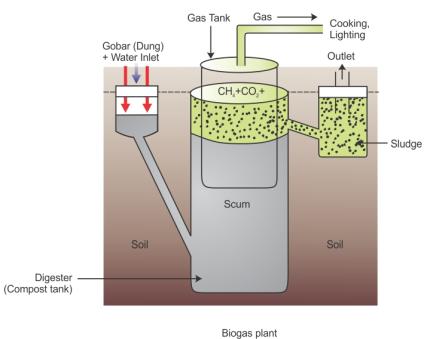 Mechanism of biogas production:
1. The biogas plant tank is fed with a mixture of dung or waste materials from kitchen and night soil along with water.
2. The biogas tank is covered with a floating lid which keeps on rising as the gas is produced in the slurry due to the microbial activity of methanogens like Methanobacterium.
3. Methanogens grow anaerobically on cellulosic material in cowdung to produce a large amount of methane, CO2 and H2.
4. The biogas plant has an outlet, which is connected to a pipe to supply biogas. The leftover slurry is removed through another outlet and is used as fertiliser.
5. Biogas is used as a fuel for heating and cooking, lighting, power for irrigation and other purposes as an alternative for firewood, kerosene, electricity and LPG. It is considered as an ecofriendly and pollution free source of energy.
Mechanism of biogas production:
1. The biogas plant tank is fed with a mixture of dung or waste materials from kitchen and night soil along with water.
2. The biogas tank is covered with a floating lid which keeps on rising as the gas is produced in the slurry due to the microbial activity of methanogens like Methanobacterium.
3. Methanogens grow anaerobically on cellulosic material in cowdung to produce a large amount of methane, CO2 and H2.
4. The biogas plant has an outlet, which is connected to a pipe to supply biogas. The leftover slurry is removed through another outlet and is used as fertiliser.
5. Biogas is used as a fuel for heating and cooking, lighting, power for irrigation and other purposes as an alternative for firewood, kerosene, electricity and LPG. It is considered as an ecofriendly and pollution free source of energy.
Mechanism of biogas production:
1. The biogas plant tank is fed with a mixture of dung or waste materials from kitchen and night soil along with water.
2. The biogas tank is covered with a floating lid which keeps on rising as the gas is produced in the slurry due to the microbial activity of methanogens like Methanobacterium.
3. Methanogens grow anaerobically on cellulosic material in cowdung to produce a large amount of methane, CO2 and H2.
4. The biogas plant has an outlet, which is connected to a pipe to supply biogas. The leftover slurry is removed through another outlet and is used as fertiliser.
5. Biogas is used as a fuel for heating and cooking, lighting, power for irrigation and other purposes as an alternative for firewood, kerosene, electricity and LPG. It is considered as an ecofriendly and pollution free source of energy.
Comments
Post a Comment